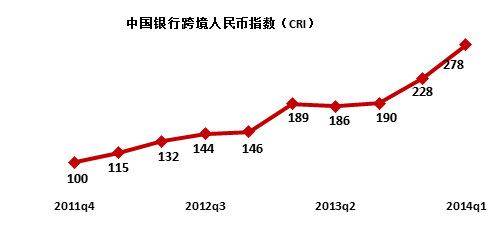
On May 14, BOC released its cross-border RMB index (CRI) for the first quarter of 2014, which rose to 278 points, reaching a new high, up 22% over the fourth quarter of 2013, and up 47% as compared with the same period of 2013. The activity of RMB use at the three stages of "outflow, circulation and backflow" has been further enhanced. The cross-border outflow outpaced backflow, which generated a net outflow momentum and indicated heightened use of the currency overseas.
RMB Use Tends to be More Active in Cross-border Trade and Direct Investment
The ratio of RMB use in current-account cross-border settlement was further raised. In terms of current accounts, during the first quarter of 2014, the country's total balance of payments under current accounts was around US$1.3 trillion, on par with the same period of last year; cross-border RMB settlements under current accounts reached RMB1.65 trillion, up 64% year on year, which reflected a broader use of RMB in current-account settlement. In terms of goods trade settlement, in the first three months, total imports and exports of goods trade nationwide amounted to US$965.9 billion, down 1% year on year; the amount of RMB settlements for goods trade was RMB1.09 trillion, up 56% year on year. The ratio of RMB settlements for goods trade against the total imports and exports of goods trade nationwide in the same period rose from 14% in the fourth quarter of 2013 to 18.4% in the first quarter of 2014.
Cross-border RMB use under direct investment was more active. With heightened level of RMB use under capital accounts, and a gradual rise in the activity of cross-border RMB disbursement, more and more domestic enterprises started using RMB for outward foreign direct investment (OFDI). The ratio of RMB use in OFDI increased from 5.8% in the fourth quarter of 2013 to 24.9% in the first quarter of 2014, which has further embodied the function of RMB as a direct investment currency.
RMB maintained a momentum of net outflow. In the first quarter, China's current-account surplus was US$7.2 billion, and net inflow of capital-account direct investment reached US$51.2 billion. However in the same period, current-account net RMB outflow amounted to RMB565.2 billion, and net inflow of direct investment was RMB137.5 billion, which, after netting of the two, made the net RMB outflow reach around RMB420 billion, representing a relatively material increase over about RMB230 billion of net RMB outflow recorded in the fourth quarter of 2013.
The Willingness of Offshore Markets to Accept RMB Continues to Rise
Overseas markets maintained active demand for RMB. In the first quarter, the RMB/USD exchange rate fell from 6.0539 at the end of 2013 to 6.2180 on March 31, 2014, with the RMB Yuan depreciated by 2.64%. However, the ratio of RMB settlement for import payment and outward foreign investment continued to rise, which showed relatively active demands for RMB in overseas markets.
Cross-border circulation promoted the development of offshore markets. Cross-border RMB circulation has led to continued net capital injections in overseas markets, and promoted the sustained development of offshore RMB markets, which helped boost the overall activity of RMB use in overseas foreign exchange transactions, bond issues, payment and settlement, and trade finance.
With the CRI continuing to hit historical new heights, the activity of RMB use in cross-border and overseas transactions has kept a rapid ascent momentum, which will strongly support the further enhancement of RMB internationalization levels.
As a major channel for cross-border RMB circulation and use, BOC remains consistently committed to promoting the global use of RMB. In the first quarter of 2014, BOC Group posted a cross-border RMB settlement volume of RMB1.49 trillion, up 71% year on year. BOC successfully issued the "Oceania Bonds" and "Schengen Bonds" in Australia and Luxembourg respectively, setting a precedent of RMB bond issuance in the markets of the two countries. The Bank injected RMB1 billion to its Frankfurt Branch, which is the largest RMB capital injection received by a Chinese bank in the euro zone, and will provide a stronger offshore RMB funding foundation for customers from China and Germany. In the future, BOC will continue to actively involve itself in the offshore and onshore RMB financial market activities, and fully support the promotion of RMB internationalization.
|


